

The Altamont Archives
The potential of a small town’s music scene realized by a budding Information Age.
“Truth be told that growing old is a curse I couldn’t wish on the best of my friends.” – Steven Hopkins, Everything Everett – How Much
After entering my late twenties, life feels a little less like a steady stream and more like a rushing river. I often find myself grasping for bits of nostalgia the way one would grasp for anchors in roots and rocks as they are swept away. That’s not to say the river is chaotically thrashing me to impending doom or oblivion; it’s simply moving me into the unknown faster than ever before. Weeks, months, and years fly by. Time has become my most precious commodity.
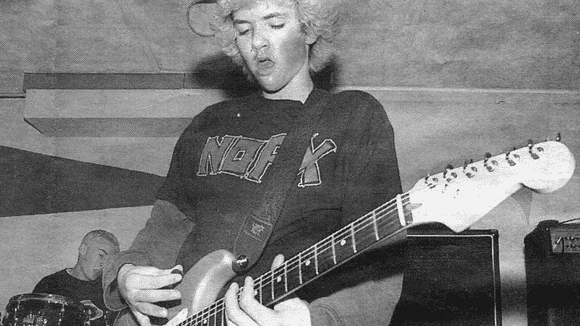
A few weeks ago, I decided to revisit an old demo recording from a high school rock band I had once been a member. As I listened back to each Seconds Late track, I found myself revisiting memories of joy, angst, and belonging. Once focused on the horrendous pang of the snare drum and out of sync strumming patterns, I was now honing into the energy and lyrics. These bits of audio were time capsule of an age on the cusp of smartphones and social networks. Messages were still handwritten. Landlines and 56K modems were still a thing.
Feeling nostalgic, I posted a status update to Facebook about revisiting these old memories. After a comment from a close friend and assistance from the greater community, The Altamont Archives were launched.
Central California
To paint the picture for those who have never been to California, it’s not all mavericks and movie stars. Those who have lived in the state will tell you of pit between Los Angeles and San Francisco referred to as the Central Valley. Most acknowledge that the biggest things to cultivate this section of the state are cattle, farms, and cattle-farms. Aside from vast plains sprinkled with tiny towns with tiny names, this much is true.
 // Seconds Late
At the heart of this area is a town called Tracy. It is a commuter town fenced in between three freeways, two of which are the most used in the state (5 and 580). Most come to know this town in passing. Some recognize it’s sister cities with a bit more enthusiasm (Modesto, Stockton, Livermore, Pleasanton, etc.). It is a city that is oft forgotten by passersby. Despite it’s 70,000+ population, it is another spit of land on the way to a greater destination.
There is a mall and a movie theater. The citizens get together on Friday nights for high school football games. There are no buildings taller than three stories. The layout is mainly residential, lending industry to the east and commercial to the west. Though, these details are not unique to Tracy. Many of the neighboring cities to the east share a similar story. Those to the west just over the Altamont Pass have the luxury of cultural run-off from the East Bay and San Francisco.
Music Industry Shift
In the late ’90s, a unique millennial intersection of technology and music sparked a fire within the unassuming towns. A new brand of music was infusing the sounds of post-Nirvana grunge, the desperation and yearning of ’90s adult-contemporary, and passion-fueled punk rock. From New Jeresy to Washington, this sound had already penetrated much of the country. Other than local commercialized record stores and MTV, many of the Central Valley towns had no outside knowledge of this new sound. Unbeknownst to many, it came creeping over the landscape like a tidal wave in the dark.
In those days, the single record store in town charged upwards of $20 for CDs of which buyers only wanted 1 or 2 songs. Most discs were strictly of popular music and if they weren’t, nobody in these small towns had exposure to anything underground. Singles were not available in abundance and for groups of middle-school and high-school kids, $20 for a song was terribly over-priced.
 // We Carry Thy Banner
By 2000, Napster hit with full force. Many were flocking to the Internet to pirate music for free. The initial response to peer-to-peer file sharing had high-school pirates with CD burners collecting $10 per disc loaded with song requests. Those privileged enough to jump on the DSL train early could turnaround a faster rate of customized playlists. At the onset of this trend, popular music was at the forefront. Those few blink-182 and Korn songs from TRL topped the piracy charts. It was not uncommon to stumble on a file named “Blink182 – New Song (unreleased)” only to find a Millencolin or MxPx track hiding inside. It was only a matter of time before these mislabeled tracks and word-of-mouth spread the names of less popular bands to the uneducated masses.
Napster had become the source of music discovery, thusly introducing small town folk to new sounds.
Building a Scene
Before Napster, many of these sounds were not readily accessible to those outside of major cities. And while it didn’t offer curated tracks or albums, it was enough to get peoples’ feet wet. The mix of common teenage culture and a new platform for music discovery had masses of angst-filled teens finding solace in choice punk rock and emo tracks. When one kid had just tripped over NOFX’s The Decline, another had stumbled across a handful of Mineral songs. The beauty of this timing meant that kids who were just beginning to pick up instruments were also getting lost in new music that spoke directly to them. Band’s in lonely parts of the country were singing about heartache, loss, and identity. For many in California’s Central Valley, this hit close to home.
The scene struck Tracy like a meteor. In the blink of an eye, everyone seemed to be in a band and those that didn’t were quick to associate with one. The trend seemed to dictate that everyone who wasn’t associated with an organized sports team had to be associated with the local music scene. These bands would practice in their garages and showcase to friends but lacked a proper venue.
As luck would have it, Les and Ronnie Trott, members of the Good Shepherd Community Church, were quick to notice the rumblings of a music scene and opened The Cellar Club.
“The Trotts, who attend the church next door, founded the club after noticing that teens did not have a place to hang out or a venue to play their music. Ronnie Trott used to host a variety show at the West Valley Mall, so The Cellar seemed like a natural progression.
‘In Tracy, we saw kids having [to] play out in the street outside of the music store,’ she said.
The couple figured the basement of the house at 1367 Parker Ave. could serve as an appropriate venue.” – Jonathan Partridge, Tracy Press, December 14, 2001
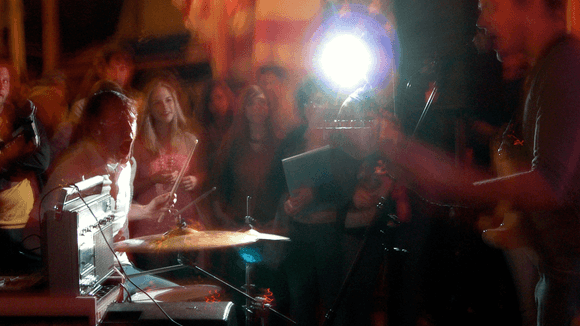
It quickly became evident that The Cellar Club had tapped a rich vein of passion, creativity, and community. It did not take long for the youth of neighboring cities and others in Tracy to hear of the buzz. Xerox copied flyers would circulate around the city, promoting shows at makeshift venues. The lobby of Tracy’s Red Dot Recording Studio on 11th opened up while parents, organizations, and bands rented out The American Legion Hall. Bands and kids from miles around flocked to Tracy on Friday evenings to see their friends play, meet like-minds, and discover new bands and songs.
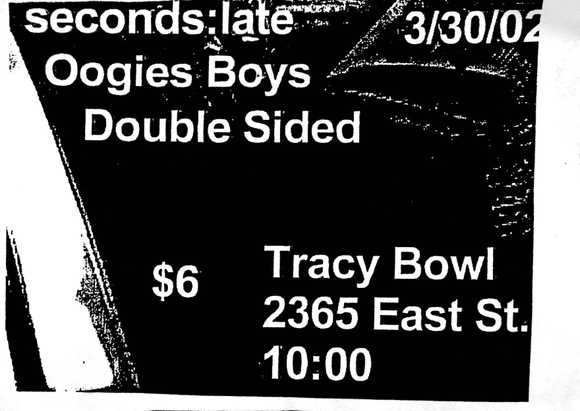
At the scene’s peak, the weekly decision between which show to attend became a paralyzing dilemma. On several occasions, band members would open at one venue, pack up and bolt to another across town to catch their favorite local band, catch-up with friends at another show, or to see if Holdfast would be debuting a new song. Missing a show altogether was devastating. It meant another week without escape from teenage politics and meeting up with a new found family.
Evolution
The lack of recording equipment and funds meant that Friday night shows were the only way to hear Don’t Punch David, swoon over Anna Tarka, or sing-a-long to The Acceptables latest catchy anthem.
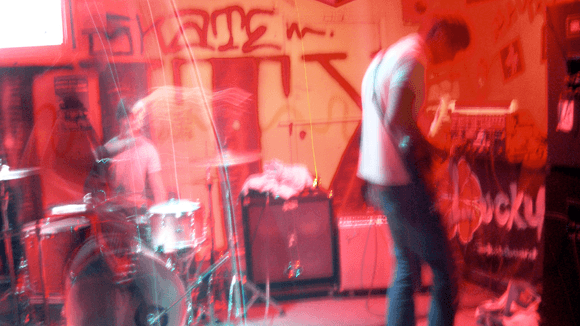
For most, recording was expensive and studios were not readily accessible. Many homegrown methods began to pop up. The use of shareware and 4-track recorders made it possible for a new bands to compile a few tracks together, burn a handful of CDs, and sell them for $5 at their next show. With little money and limited access to larger record stores, new music from local bands were highly sought after for fans and bands alike. For fans and friends, songs that were likely only heard once per month during a band’s performance could now be replayed in cars, homes, and Walkmen. For most, these songs were more exciting and personal than anything on the radio or available on Napster. They were a means of comfort, pride, and evolution. To small town kids, the notion of a band’s potential felt like a portal to a much larger world.
 // Family Tree
While the Internet was still figuring itself out, the inklings of Do-It-Yourself (DIY) media distribution were there. The birth of Geocities/Angelfire meant that every band could promote their upcoming shows. The lack of social media encouraged a frenzy of repeatedly checking MP3.com for a band’s newest recording. While Napster was still present and distributing slices of the larger music industry, the scene’s community seemed to nurture the bands in the area with intense and endearing love.
As much as they enjoyed watching their friends (and rivals) play, a careful audience would analyze how others were writing and performing. New techniques and conversations led to seeds of inspiration. At Friday night In-N-Out after-parties, members of the community were quick to share newly discovered music with others in hopes that it would help evolve the scene’s sound. Music from The Get Up Kids, Counterfit, Further Seems Forever, Thrice, Thursday, Coheed and Cambria, Elliott and many others became sources of musical and lyrical influence.
At the onset, the scene was mainly comprised of bands that were attributed to some form of punk. A shift from these punk rock roots was splintering into post-hardcore and pop-punk. Members of defunct bands joined up with others to create local supergroups. Sloppy power-chord punk was being replaced by tricky time signatures and pedal boards. Everything Everett were known to seamlessly move from their slick Boys of Summer cover into the brooding, atmospheric, heartbreak powerhouse Mouse.
Beyond the Borders
As the scene grew up, it’s presence spread from Stockton to San Francisco. Shuffling musicians would lend their talents to other bands in other cities. The slew of untrained musicians now understood their instruments, honed their pop-sensibilites, and delivered energetic and mesmerizing performances. During Routine‘s (formerly Fixer) sets, audience members had difficulty choosing which highly technical musician to focus on.
As recording became more accessible, bands began to broaden their production technics. Verdu Harding played with layered vocals and programming, offering darker ballads a la Finch and Glassjaw. Holdfast’s later recordings featured tight and powerful production while others began investing large amounts of time in learning engineering techniques. Many bands ventured to Turlock to record with Dan Petersen of Fairwell Madison while others set off to a professional studio in Oakland.
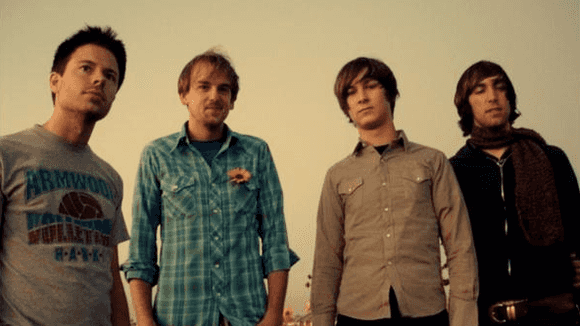 // Family Tree
Around 2004, a majority of the scenes proprietors had made their way out of the region and set off to college, relocated, or took up adventuring in San Francisco. The technical prowess of Routine eventually parted ways, members breaking off into the American Football-esque Of The Swaying Sort, Counterfit influenced Family Tree, and Nada Surf tinged Lovetaker.
A collection of long-time friends formed Bel-Air Academy toured the country and released the full-length Repeat This Over on Stowaway Records, produced and engineered by Holdfast’s Tim Eagerton.
After two self-produced full length albums, members of the defunct Fairwell Madison formed Evaline (formerly known as Holiday). As one of few success stories from the scene, they released two EPs (Postpartum Modesty. A Portrait of Skin, Patterned) and the full-length Woven Material, toured the globe, and played the London iTunes Festival in 2011.
Time/Place
The scene was a product of being grounded in a small town and the birth of digital enabling. It occurred at a unique time in a unique place. Before today’s ability for anyone to self-produce audio at a near professional grade, early Internet technologies allowed established garage bands to showcase their scrappy recordings beyond their local fan base. Early webpage providers allowed for promotion of shows, news, and new content to markets that were once out of reach.
With today’s technology, a single person can record a professional sounding full-length record, self-distribute, and promote across social media; all without leaving the comfort of their bedroom. In the early ’00s, music discovery came in the form of an accidental download of a song that quickly turned into their discography; or a chance encounter with local legend who handed passed on a burned copy of a mysterious album in a dark rainy parking lot; these moments were life changing.
I like to believe that small music communities fostered by the cusp of the Information Age were something special. I like to think that this blip of time in these blips of cities actually mattered and that the bands deserved something bigger. I like to dream of the music they would have created if they were financially support and picked up by labels. I like to reminisce about a time when a local band’s new song was the trending conversation at school; a time when the magic of a band’s evolution unfolded, quite literally, in front of your eyes. Validation came in the form of agape mouths, awestricken faces, and congratulations at In-N-Out after-parites. Your closest friends, now family, sang your lyrics right back at you.
We built a tiny kingdom; something that never dawned on the eyes of pop culture, yet monumental enough to harbor a culture of its own. People believed in our scene. It was a savior, an adventure, and an identity at a time when most kids, especially those in small towns, didn’t have one.
The Altamont Archives are a glimpse into these memories; a time capsule of sorts. A time when community and belonging did not come in the form of followers or likes, but in hugs and real-time praise. The energy of a show could not be broadcast on Instagram or Vine. You had to see it to believe it.
Maybe this post is the rambling of a man who has a hard time letting go, craved for nostalgia as he realizes 10 years suddenly slipped by. Maybe this post will strike a chord for those that played a part in one of the most memorable and sentimental times in his life. Maybe it will spread as a murmur to folk outside of the arena, reigniting memories of similar sacred pastimes. Maybe it will garner some interest from a semi-relevant editorial outlet or tech historians. Maybe it’s just a way of reflecting; an opportunity to say, “I was in a band.”
Originally published on TheStarrList.com
Available albums:
Bel-Air Academy – Repeat This Over ( iTunes | Amazon MP3 )
Bro Montana – Defense ( iTunes | Amazon MP3 )
Evaline – Woven Material ( iTunes | Amazon MP3 )
Evaline – Patterned EP ( iTunes | Amazon MP3 )
Evaline – P_ostpartum Modesty. A Portrait of Skin EP_ ( iTunes | Amazon MP3 )
Normal Like You – Planes Trains & Automobiles ( iTunes | Amazon MP3 )
Normal Like You – The Worst of Many Flaws EP ( iTunes | Amazon MP3 )
Normal Like You – Your Reminder ( iTunes | Amazon MP3 )
We Carry Thy Banner – We Carry Thy Banner ( iTunes | Amazon MP3 )