

Kids react to Game Boy
http://www.youtube.com/watch?v=0pCp8g-VjOs
Game over. Get off my lawn.
http://www.youtube.com/watch?v=0pCp8g-VjOs
Game over. Get off my lawn.
Disney characters are not as familiar to my kids as they were to me when I was their age. Perhaps it is because they have tablets, gaming consoles, and laptops. Their pop culture universe is dominated by Minecraft, Mario, Clash of Clans, and Pokemon. YouTube gamers are celebrities to them. While they (and I) enjoy those new Mickey Mouse shorts on the Disney Channel, we rarely set out to watch something because of the Disney brand.
I love Disneyland. Probably more than most. So much so that my NaNoWriMo novel took place within the gates if the Magic Kingdom. I have long dreamt of becoming a Walt Disney Imagineer; brainstorming, collaborating, and bringing to life grand new experiences for park guests. The idea of immersing myself in work that turned imagination into reality (even if it meant laying the brick myself!) always sounded… right.
However, I had an eerily similar thought last night. After setting down my copy of Console Wars by Blake J. Harris, I asked myself if I’d rather work for Disney or Nintendo?
Nintendo is full of characters I grew up, full of characters I love. Being born in 1985, the year the Nintendo Entertainment System (NES) was brought to North America, Mario, Mega Man (Capcom aside), and Link (rather, the name I chose) were the characters that ushered me into the world, and I them. These characters had no personality, just a mission and they need me to achieve it. They required immersion and connection.
Being raised in a world where the participatory nature of video games was quickly becoming the norm, I’m not sure how much observing a character or watching the moral to a story unfold actually affected me. I was obsessed the Aladdin’s Genie because he made me laugh, but until I really understood the nuances of storytelling and scope of reality (probably somewhere in mid-high school), I’m not sure I really identified with any Disney character. I just knew I wanted to be the good guy.
After spending the weekend enjoying Mario Kart 8 with my fiancée, I thought about how much joy the characters of the Mushroom Kingdom brought me; I thought about how excited I was for Captain Toad: Treasure Tracker, or how I would jump at the opportunity to buy the next Luigi’s Mansion installment, or how I wish Nintendo would launch a Princess Peach and Daisy centric title.
Don’t get me wrong, working as a Walt Disney Imagineer or in Nintendo’s Treehouse sounds like more than any fan could ever ask for. But given an equal opportunity at both, I’m not sure which I would choose. I don’t think I’m the only one from my generation who sits on this fence.
In a connected society full of massive, customizable, open worlds and bite-sized mobile games, will post-millennials fantasize about either? If we live in a perpetually fantastic world, does reality become the new fantasy?
According to console sales data fromVGChartz, Nintendo was selling an average of about 29,000 Wii U consoles per week prior to Mario Kart 8′s release. The week Mario Kart 8 hit store shelves, over 130,000 Wii U consoles were sold. Even three weeks after the release, sales were still more than double their pre-Luigi-Death-Stare levels. All-told, Mario Kart 8 has sold an additional 207,000 Wii U consoles in just three weeks.
But it gets even more interesting when you compare the Wii U’s big system-seller with the exclusives that have come out in the first half of 2014 on the other two consoles.
March saw the release of both Titanfall for Xbox One and inFAMOUS: Second Son for Playstation 4. The sales boost from Titanfall only lasted two weeks and moved about 94,000 additional Xbox One consoles. The sales boost from the Seattle-set Second Son lasted three weeks and moved an additional 106,000 PlayStation 4 consoles.
I can’t help myself: Hail Mario.
http://www.youtube.com/watch?v=XOC3vixnj_0
Is looking around a room and finding an eyeball in a wall really super fun for people? Like, the game is 3D now so everything isn’t laid out before you like a map anymore, so I get that there’s this sense that you walk into a room and aren’t getting all the information about the room right away. But is stopping your forward motion, stopping everything to look for a diamond to whack that’s in a soulless crevasse in the wall so you can open a door that leads to another room with a locked door and some other silly open-sesame trick… is that fun?! Is this what you want?!
Let me explain something. A puzzle is something you have all the information for. The only thing standing between you and the solution is your own ability to put the pieces together in the right way. The satisfaction you obtain from solving a puzzle is from the “a-ha!” moment when the pieces fit and you have only yourself to blame for it.
If you’re missing a piece, how are you even supposed to get to a conclusion? You rack your brain; run in circles; go, “what do I fucking do?!” until you find the last piece on a whim and suddenly it all makes sense. You say, “Well shit!” or, “Ah, come on!” The satisfaction doesn’t come from the door opening, it comes from the puzzle itself. If the puzzle itself isn’t satisfying, well there you go. The puzzle itself isn’t satisfying.
Arin Hanson just ripped apart my favorite game, and I am very okay with that. Great video on game design and (ultimately) Nintendo’s return to the origins of the Zelda franchise. Worth every second.
Instead, pixel art is best thought of as video gaming’s most characteristic visual style, one that was forged throughout the history of the medium and is inextricably linked to it.
A great post at The Verge today. Pixel art is and forever will be the most emblematic representation of the video game medium.
Adam Saltsman, creator of Canabalt:
Pixel art doesn’t always spell everything out. It can be pretty minimalist and evocative that way. Often when you are looking at pixel art you are seeing more than is actually there.
After Nintendo released The Legend of Zelda: Ocarina of Time 3D in 2011 (a remastering of 1998’s original LoZ: OoT), many were quick to point out that it had been rebuilt as the game you remember, not the game it actually was. Our imaginations have the wondrous ability to fill in blanks and fill out details that may not actually be there. This seems to be the reason I have no quandary with the evolution of Mario. I have never questioned this:
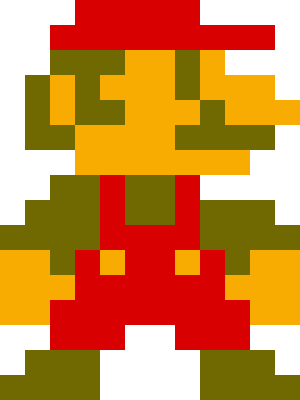
from this:
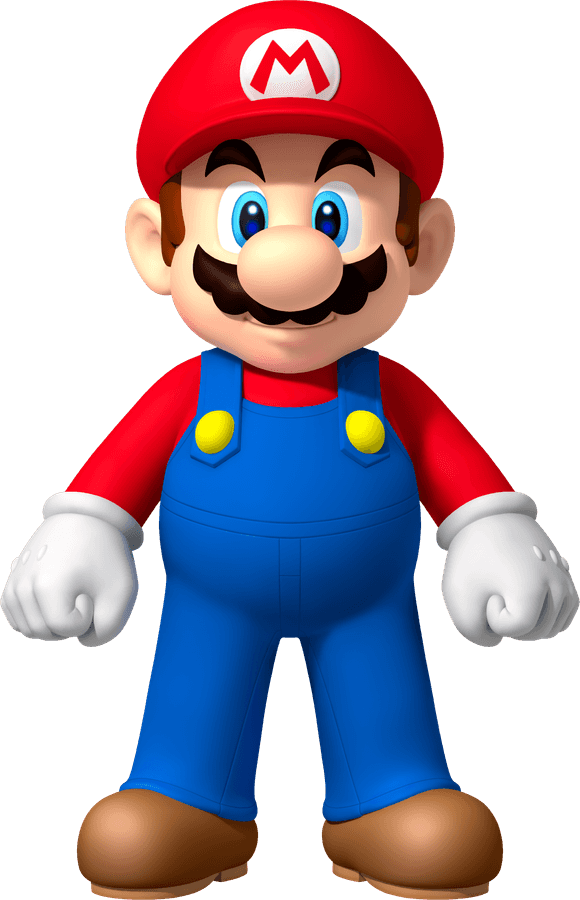
Red cap, mustache, overalls? Sure, that’s Mario.