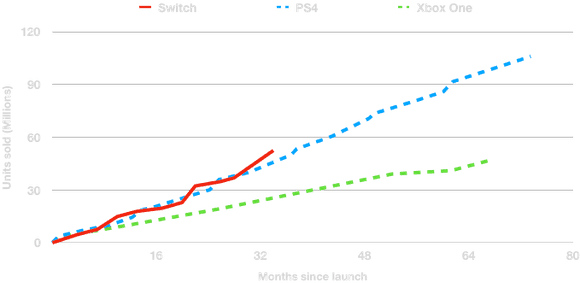
Estimates: Nintendo Switch passed the Xbox One in hardware shipments

Daniel Ahmad, senior analysts at Niko Partners, regarding Nintendo’s FY19 Nine Months Financial Results Briefing:

Also worth pointing out that according to our estimates the Nintendo Switch passed the Xbox One in hardware shipments during the holiday quarter last year.

The Xbox One is not too far behind, but it has only taken Switch 34 months to achieve what the Xbox One did in 74 months.

Nintendo reports that they have shipped 52.48 million Switch units since launch. It’s estimated that Microsoft has sold 46.9 million Xbox One units since launch. 5.58 million more units in nearly half the time.

On the Playstation front, while it’s been a back-and-forth race, it took Sony over 37 months to ship the same number of consoles as the Switch.

Here’s an updated chart for perspective:

Console units sold, Switch vs PS4 vs Xbox One as of January, 31 2020

The Switch also appears to be leaving it’s older sibling—the 3DS—in the dust:

Console units sold, Switch vs 3DS as of January, 31 2020

Star Wars: The Rise of Skywalker — A Review

Star Wars is about balance. Light versus Dark. Jedi versus Sith. One versus one. Should the Force fall out of balance, chaos ensues.

The Rise of Skywalker epitomizes balance — balance in story; balance in heritage; balance in its namesake.

This will not spoil. It is intended to be read after viewing the film. This is due to a balance in context versus content.


It is fun to watch J.J. Abrams play in the sandbox of Rian Johnson before him, as it was fun to watch Johnson play in the sandbox of Abrams before him.

Abrams built up what Johnson tore down, and thus Abrams is challenged to rebuild from those pieces. To construct a cohesive narrative, Abrams must construct something cohesive from the rubble Johnson laid before him.

Like Empire after Hope, Johnson laid waste to the monomyth laid before him. He’d done away with nearly every construct setup before him. Rey’s parents are nobodies. Snoke was an easy kill. Luke’s saber means nothing. Like an angsty teen, Johnson throws away legacy. He wants to define his own path. The Last Jedi is punk.

By blowing The Force Awakens to hell, the return to its author had to be nothing but a challenge. Abrams is forced to not only to piece together loose ends, but also tie it up with a satisfying bow.

If Kylo’s helmet is a symbol for this third act, The Rise of Skywalker is the valiant effort to salvage the pieces it was born from.

Fast vs. Slow

The Rise of Skywalker is fast. Maybe a little too fast. Fast to the point where it feels like it’s doing its best to ignore The Last Jedi. It simply wants to snap into The Force Awakens, working as it’s own Star Wars trilogy second and third acts in a single film. But as soon as one feels that way, there are questions and weight from The Last Jedi that must be answered — Jedi books, helmets, and Force ghosts, etc.

The Rise of Skywalker is slow. This is a third act that feels like a single film full of third acts. It’s relentless, but moves at a slower pace than that of The Last Jedi. There is less plot than there is filling gaps or doing the grunt work of attempting to reconstruct Johnson’s deconstruction. By the end, I had a hard time remembering the beginning or even caring about it for that matter.

Big vs. Small

The Rise of Skywalker is big. This film above all other Star Wars films feels massive. The scale of the fleets. The cinematography of the ships. The velocity of light-speed chases. The variety of planets. The sheer magnitude of the shots is breathtaking. Impossible odds haven’t felt so impossible since the first front on the Death Star in A New Hope.

The Rise of Skywalker is small. The relationships feel small. Where The Last Jedi expands familial, friendly, and sexual bonds, The Rise of Skywalker contracts them into a focused few. The stakes stay within the family. The stressors are on individuals. Our heroes and their connections to each other and themselves are at the heart of this story.

Fan-service vs. Familiar

The Rise of Skywalker is fan-service. Every “I” dotted”. Every “T” crossed. The Rise of Skywalker pays tribute to the series to date as a whole. Yes, to the point of eye-rolling, but that could be seen in The Force Awakens, between the Death Star 3.0 (Starkiller Base) and the new Cantina band. The Rise of Skywalker goes above and beyond these callbacks by embracing Johnson’s (or even Gareth Edwards’ (Rogue One)) ideas and even playing them up every now and again. Anything seems possible in the Star Wars universe, and if I surrender to the idea that this is all make-believe, I’m ok with that.

The Rise of Skywalker is familiar. While the fan-service is welcome, we’ve seen this story before. None of the encounters feel magical. None of the cameos feel surprising (save for one, maybe two). The Last Jedi and The Force Awakens before it did a great job shocking the audience with unexpected moments, be it live-action puppeteering or reappearances of deceased characters. The Rise of Skywalker has plenty of fun, but it feels like we’ve been there before.

Rise of Skywalker

Between these three aspects — fast and slow, big and small, fan-service and familiar — it may be the speed that gets in the way the most. I struggled to care about the characters. I remember them from the previous films, but I did not have time to reconnect with them. If The Rise of Skywalker has shown anything, it’s that Johnson is the gravity to Abram’s lightness. The Last Jedi made us feel the depths of characters and the internal demons they were facing. The Rise of Skywalker seemingly doesn’t have time to dwell on that and tries to race to the finish line, soon realizing it still has another hour of story to tell.

Where The Rise of Skywalker shines is in its balance. There is balance in how Abrams and Johnson handle the saga. There is balance in the pace of each of the films. But speaking to The Rise of Skywalker in particular, the title speaks to balance most of all.

Hail Mario 3: Revenge of the Stock

Cameron Faulkner at The Verge:

Nintendo has announced its Black Friday deals, and chief among them is a $299.99 Switch console bundle that includes a free download code for Mario Kart 8 Deluxe. This deal will start on Thursday, November 28th, and will be available at several retailers. So far, we’ve seen it confirmed in Target’s Black Friday ad, but expect it to pop up at the other major players, like Best BuyWalmartAmazon, and more. 

Getting a free game with the Switch is great, especially one that’s as good as Nintendo’s popular kart racer, but there’s some fine print with this deal that you may, or may not, care about. You’ll only get the free game with the HAC-001 version of the console, the original launch model that has been superseded by a new version with vastly superior battery life (a range from 4.5 to nine hours versus the original’s 2.5- to 6.5-hour claim, depending on the game). 

This deal might read as a way for Nintendo to clear out its remaining stock of launch units without cutting the price, but thankfully, the older version is no less capable, and crucially, no less fun to play on.

I’m willing to bet Faulkner is correct here.

I’ve written about Nintendo’s use of Mario Kart 8 as a unit mover. For the Wii U, it was used as a final Hail Mary to reinvigorate Wii U sales with not only the game, but a very early review embargo and a free additional game. For the Switch, it was a the first widely recognized party game to offer local multiplayer support, allowing early Switch adopters to showcase the console’s unique modes of play ahead of the holidays, namely table-top mode — the mode that allows two local players to play anywhere, each leveraging a single Joy-Con as a controller and prop up the Switch as the screen.

Here we are on the other end of the spectrum. With the wild popularity of the Switch and a relatively new SKU that boasts better battery life, what better way to exhaust stock of the original SKU than to throw in arguably the most polished, popular, and accessible game in Nintendo’s library for free.

Polygon’s 100 Best Games of the Decade

Polygon Staff:

We began with a long list of around 300 games that team members nominated. Then we individually voted for the 50 we most wanted to see in the list. After we tallied the votes, we gathered together to sort out the unholy mess, and to argue the merits and faults of the top 150.

After a surprisingly calm and erudite discussion, we agreed on the following list. It is, by its nature, a compromise, but it’s the best we’ve got.

A fun look back at a decade that now seems shorter than it felt — I’ll blame that on the past three years.

I played 23.5 of the 100 titles mentioned in this list. Honestly, that’s more than I thought I would have. (While _Red Dead Redemption_s 1 and 2 are counted as a single entry, I only ever played the first, so it counts as half.)

As I have a soft spot for Nintendo games, I’m happy with Polygon’s Mario pick over what I assumed would be the shoo-in. Likewise, I’m happy to see an overwhelming industry/fan/consumer favorite sit extremely high in the list at number 2, but not receive top honors. Societal/cultural impact takes precedence here, as I argued back in 2016.

My biggest takeaway is that the past 10 years of games have broadened the scope of what constitutes a “video game” more than any other decade. That seems an obvious observation as there’s evolution in any medium, but video games by their infinite malleability allow for innovation and creativity beyond any other. Video games can be anything (and therefore video games do not exist). Just read Polygon’s justifications for Device 6, Johann Sebastian Joust, or Journey.

If 2000–2009 cracked the door on infinite possibilities, 2010–2019 blew it wide open.

Video Games Do Not Exist

I was invited to write an original piece for the then patron exclusive ‘From the Aether’ newsletter, the text extension of the wonderful Into the Aether podcast. As of December 9, 2019, the piece became available to the public.

With permission from Into the Aether, I’ve published the full piece here, but I’d love it if you gave it and the other wonderful accompanying pieces a read on Medium.

I encourage you to listen to the podcast. If you’re so inclined, become a patron of an insightful and welcoming low-key video games podcast.


The year is 20XX. Video games do not exist. They never have.

But tomorrow they will.

And when they come, all of today’s modern technology and tools will be available to their creators. There will have been no precedent other than their analog counterparts, which — come to think of it — consist of cardboard, cards, metal or plastic tokens, dice, tiles, paper, pencils, backpacks, guns, talking… walking… geese…

The first ones will be clunky; nigh unplayable. But without limitations in technology, we’ll quickly learn what’s acceptable, butt up against new limitations, and impose our own.

The first will feature a camera moving around a space. The next will include music. Then voice over. Then a third-person perspective and objects to interact with. Some will simply be digital recreations of analog forms. Maybe you’ll simply speak to them. Maybe you’ll move a character from left to right, or maybe right to left. Maybe you’ll console a character. Maybe that character is actually a real person. Maybe you’ll discover the nuance of an intimate relationship, or the complexity of geopolitics. Maybe all you’ll do is observe and sustain an ant farm, a household, or a city. Maybe it’ll strictly be text, or nothing at all — just a voice.

You’ll play them on a smartphone, a first-party handheld device, a TV, a computer, a watch. Perhaps you’ll play these through goggles or virtual assistants. Maybe your phone will ring or you’ll receive a text message that informs you to open an email that tells you to navigate to a particular GPS coordinate in your neighborhood, then open an app to reveal a new clue.

Each is an experience. Each requires an interaction. But they are not simply interactive experiences. The act of reading these words, right now, is an interactive experience. The mode of input varies. The goals vary. The display, playback, or broadcast will vary.

Perhaps the constant is a digital device. It may not be the only artifact necessary to partake in the experience, but it’s a requirement.

Perhaps the other requirement is agency or the illusion thereof. You’ve been spewing thousands of opinions on social media, but you know damn well that you have no control or influence to change the world in a single tweet. But in this limited, digital experience, you play god. An analog god over a digital domain.

So, what are these things? What are these experiences? Some are games. Some are simulations. Some are stories. Some are lessons. The same as any form of book.

But they don’t come on paper. They come to us through video — “an electronic medium for the display of visual media”; a screen — but maybe also a speaker, or require a pen and paper.

With unlimited creativity and technologies that can produce images that rival reality, these things reshape what we know of interaction and storytelling. They unlock our ideas of what worlds and systems should or shouldn’t be — human-made full-sensory utopias and dystopias. They are as simple as connecting dots and as complex as connecting people.

So, what do we call them?


[Edit] This piece was updated on December 9, 2019 to reflect the public availability of ’Video Games Do Not Exist‘.

[Edit] This piece was updated on December 28, 2020 to include full text of ‘Video Games Do Not Exist’, with permission from Into the Aether.