Monument Valley, post-House of Cards

Michael Martin, IGN:

Main character Frank Underwood (Kevin Spacey) is seen playing and describing the game in the fifth episode of the hit Netflix series. As a result, the game has soared into the top 10 top paid apps on iTunes, where it currently resides at number five and is number three in the paid games category on the Google Play store. The game did not rank in the top 25 on either app store before appearing on the show.

Speaking at GDC 2015, ustwo lead designer Ken Wong said the show’s producers reached out to the developer about the game appearing in House of Cards at no cost to the studio, according to IB Times.

“They called us up and they said, ‘Can we use your game?’ and we said ‘Yes,’” Wong said.
Be more Disney, less Vegas

IGN’s Seth G.Macy reporting from PAX East:

“Any item that affects game play,” he told the audience, can be acquired “through grinding.” He compared his ideal F2P model to Disneyland, saying that when a person visits the park, they have the choice to spend money as they see fit once inside, but they can still enjoy and experience all the park has to offer. He contrasted that with Vegas, where the push to spend to increase enjoyment is non-stop.

“Be more Disney, less Vegas,” he said. Bleszinski also said that Boss Key is watching and taking note of the people on the forums and on reddit who are offering suggestions and participating in the community, hinting that they will be rewarded for their participation.

This seems like a very misguided comparison. Bleszinski seemed to skip the part where you pay to enter Disneyland. Get the most out of a $99 single park ticket means a Disneyland guest will spend anywhere from 11 to 16 hours in the park. Guests can bring food and drink into the park, but the realistic chances of anyone bringing in three meals plus snacks sounds overly ambitious. Needless to say, food will be purchased. And if a guest has gotten by without spending a dime inside of Disneyland, they still paid to enter. This is no where near a free-to-play model.

21 Percent Delta

Polygon’s Charlie Hall reporting from GDC 2015:

Rosalind Wiseman and Ashly Burch collaborated to create their survey in the spring of 2014. Wiseman, herself a teacher, educator and author, was able to deliver the survey to 1,583 students aged 11 to 18 over the course of the year. The results, the authors say, are enough to turn the games industry’s understanding of gender issues on its head.

The most compelling data point for game developers is the fact that girls in high school are far more likely to prefer to play female characters than boys of the same age are likely to prefer to play male characters.

Only 39 percent of high-school aged boys surveyed preferred to play as male characters, while 60 percent of high-school aged girls preferred to play as female characters.

That 21 percent delta, the authors say, is more than enough reason for game developers to rethink who their main characters should be going forward.

“We as developers,” Burch said, “understandably … are afraid of our games not selling.

“It’s terrifying to imagine that your game’s not going to sell. But it could be that we are falsely attributing the success of past games to things that don’t actually matter to the kids that are playing them.”

Since hearing Rosalind Wiseman on The One You Feed podcast, I’ve been an avid fan of her and Ashly Burch’s work. In case you missed it, their GDC 2014 talk on The Connection Between Boys’ Social Status, Gaming and Conflict is worth the watch.

See also: My recent breakdown of protagonist gender and video game genre from the games announced or highlighted at E3 2014.

E3 2014: Genre/Gender Breakdown

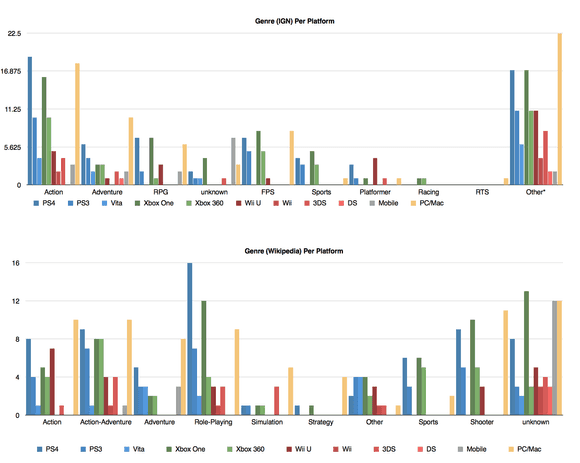
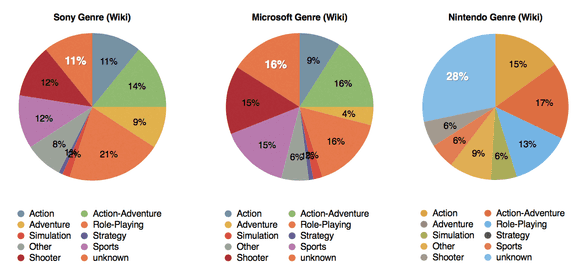
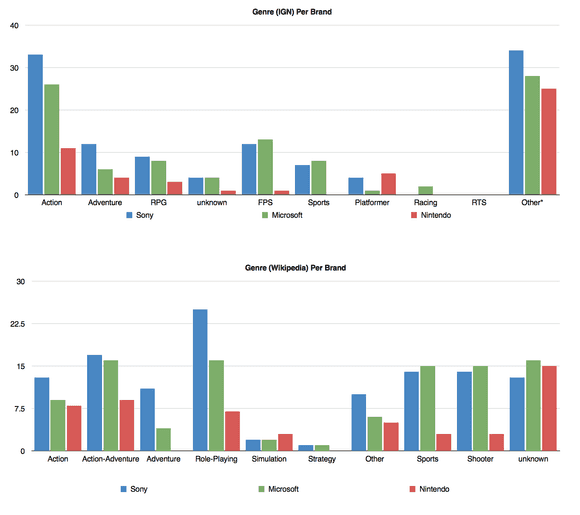
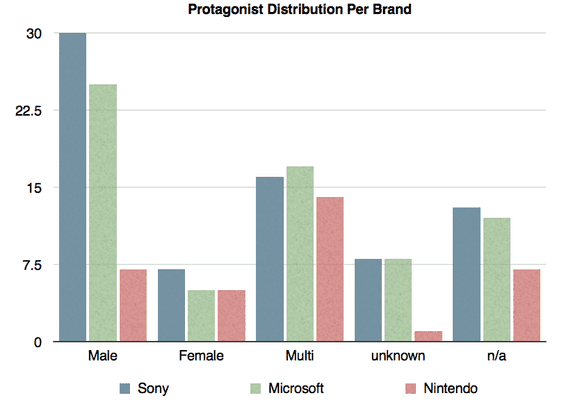
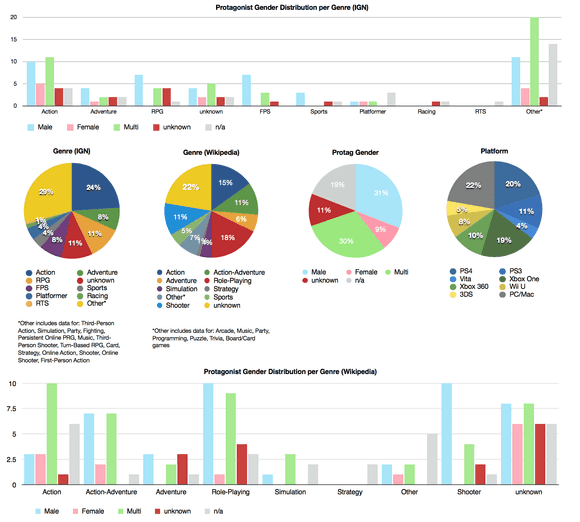
Continuing my research of video game genre and protagonist/main character gender, here is the collected data from E3 2014. The sample list of 152 video games was sourced from IGN’s Games at E3 2014, platform data mapped to a quantifiable “TRUE”/”FALSE” list, genre lists collected from both IGN and Wikipedia (limited to primary genre), and the main character gender researched to the best of my ability.

Elaborating on the gender categories:

“Multi” being either:

  • multiple characters to select from (ie. Mario Kart 8 / Killer Instinct receive 1 count for “multi” although there are several characters to select from)
  • customizable gender
  • large customizable party

“n/a” being a:

  • gender ambiguous character
  • god-view game
  • first-person with no direct gender association

E3 2014, protagonist gender distribution per genre

E3 2014, genre per platform

E3 2014, genre per brand (pie chart)

E3 2014, genre per brand

E3 2014, protagonist gender distribution per brand

Some key points:

  • My data can be found here. (Numbers online)
  • Sample size = 152 games
  • 13 exclusively female protagonists/main characters vs. 47 exclusively male protagonists
  • Female protagonists by year:
    • 2012: 2%
    • 2013: 6%
    • 2014: 9%

Additional reference:

Re Netflix-Zelda: What is Game of Thrones without George R. R. Martin?

The Wall Street Journal:

The video streaming service is in the early stages of developing a live action series based on “Zelda,” about an ordinary boy named Link who must rescue a princess named Zelda and save a fantasy world called Hyrule, said a person familiar with the matter. As it seeks writers to work on the show, Netflix is describing it as Game of Thrones for a family audience, this person said.

As it is still seeking a writer to work on the series, Netflix has a long road to travel before a “Legend of Zelda” series actually becomes a reality. It’s also possible that Netflix or Nintendo will kill the project before it gets off the ground.

Considering Netflix’s vision without a writer, I’d say this has a very long road to travel.