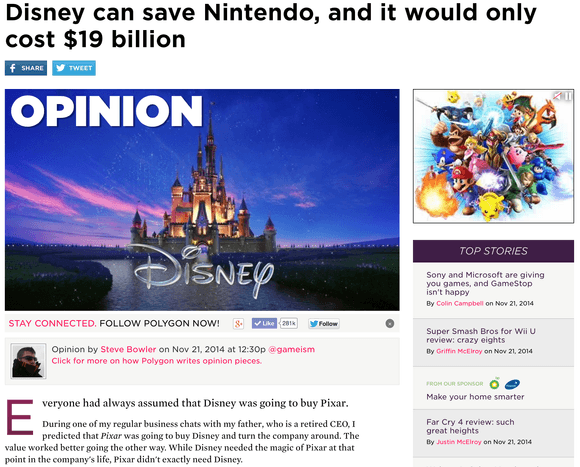
'Disney can save Nintendo, and it would only cost $19 billion'

Steve Bowler, writing for Polygon:

Disney wouldn’t see Nintendo as a hardware company or even a software company, just as they didn’t see Marvel as a comic book company. Nintendo holds some of the best intellectual property in the world, from Mario to Link. Kids are still wearing Mario and Luigi shirts next to their classmates wearing Minecraft and Iron Man logos.

There are incredible properties, from Metroid to F-Zero, that would offer Disney huge opportunities in everything from film to theme park attractions. Nintendo, when looked at through the lens of an acquisition, is a bundle of amazing, well-known characters and worlds that are criminally underused.

Nintendo is the last company that owns characters that could compete with the worlds that Disney already controls, and adding Mario to the Disney original characters, Marvel superheroes and Star Wars would mean that Disney all but owns entertainment as a whole.

I initially scoffed at this article as a pipe dream so many of us have already had (especially yours truly), many after watching Wreck-It Ralph. One could sketch Nintendo franchise themed rides over a map of Disneyland. (Peach’s Castle in the hub, Metroid and Star Fox in Tomorrowland, Fantasyland becomes Hyrule, Donkey Kong in Adventureland, etc.) We have all certainly envisioned a reboot of the Super Mario Bros. Super Show using Super Mario 64 to current era models, worlds, and voices(?). Of course this sounds awesome/mind-blowing/impossible.

But then the reality of it all hit:

Star Wars is Disney.

Marvel is Disney.

It was as if I had never really given weight to the thought. Nintendo has always been so evident and ripe to fit along classic Disney franchises. But Marvel and Star Wars? Put in the context of Disney buying Nintendo and Nintendo just seems like a no brainer put up against the other two.

On the flip-side, the majority have been spelling doom for Nintendo for years. And Nintendo has been putting up one hell of a fight. Let’s see how these Super Smash Bros. numbers do.


[UPDATE]: How about that ad to the right of the piece?

Polygon headline: Disney can save Nintendo, ad placement

Golden Age Thinking

I’ve never felt as old as I had this morning. I kicked off my day watching Stuart Brown’s Brief History of [Video Game] Graphics. On my commute to work, I listened to Johns Gruber and Moltz discuss ’80s computing technology on The Talk Show.

Being born in ‘85 (we may as well call it ‘86), some of topics discussed in both of these pieces grazed the edges of my memory but weren’t so far off that I couldn’t muster up a sliver of recognition or plausibility for the topic at hand. However, many of the subjects and terms (DOS, floppy disks, “raster”, 8-bit, etc.) had me pining for life in an earlier time. A time when faster, smaller, cheaper meant a Gameboy vs. Gameboy Pocket; not a 250GB 2.5” HDD vs. 3TB of cloud storage. It may seem crazy to wish for a pre-Internet era, but then again, Golden Age Thinking is crazy.

Paul (Michael Sheen), Midnight in Paris:

Nostalgia is denial - denial of the painful present… the name for this denial is golden age thinking - the erroneous notion that a different time period is better than the one one’s living in - it’s a flaw in the romantic imagination of those people who find it difficult to cope with the present.

I then got to thinking about my mother’s lack of interest in technology. She’s on a candy-bar phone, still abides by a phone book, and prints out directions from MapQuest. Maybe she was never focused on her Golden Age as much as she is comfortable living in it. Where she stands in the current tech landscape is likely a Golden Age for others.

I love technology, but at some point (and I don’t feel it’s too far off) I will I call it quits on trying to keep up? Will I settle in what will become a future someone’s Golden Age? All I know is that this morning, I was the guy in the 7 year old car (my wife drives the new one) listening to talk radio (podcasts) on a 2+ year-old smartphone (I’ve been upgrade eligible for months). And today’s music is terrible. And I’ve been to a movie theater once in the past year. And there will never be better TV than Seinfeld. And I don’t understand EDM (Electronic Dance Music / Erotic Dancing Miley / Exorbitantly Deep Minecraft). And I’m comfortable.

'The making of Captain Toad: Treasure Tracker'

Danielle Riendeau of Polygon in an Captain Toad: Treasure Tracker producer and director Koichi Hayashida and Shinya Hiratake:

“We began with Super Mario 64,” Hayashida told Polygon via video conference. “While Super Mario 64 was quite an interesting game, we heard that roughly 20 percent of gamers found it too difficult,” he said, brandishing a copy of the Nintendo 64 game. “We kept that comment that the game was too challenging and made games like Super Mario 3D Land and Super Mario 3D World with that in mind.”

But, in making 3D Land and 3D World, the team felt it was getting away from a fundamental design principle that made Mario 64 so special: the idea that the levels were a sort of “diorama” or a “garden in a box,” entire worlds contained in relatively compact structures. In creating the Captain Toad stages for Mario 3D World, the studio was able to go back to that idea, and keep the challenge level accessible.

That’s how the team created the handful of stages starring Captain Toad for Super Mario 3D World. They represented a different style of play from the traditional 3D platforming in the rest of the game — slower paced and more cerebral, they offered players something of a refresher between obstacle courses and cat-powered wackiness.

In addition to the variety of interesting cross-overs and spin-offs, it seems like Nintendo has been a bit more open as of late, offering more peaks behind the certain.

As for Captain Toad, I love that Super Mario 64 stands as its foundation. However, my favorite part of Super Mario 64 is the challenge. It is always great to take a swing at impossibly difficult missions year after year. There is almost a “young grasshopper” feel to it. I hope Captain Toad: Treasure Tracker’s accessible “challenge level” isn’t too far removed from Super Mario 64.

Either way, this interview solidifies my thought that Captain Toad: Treasure Tracker is genius.

Kate Upton and Game of War

Paul Tassi writing for Forbes:

It just seems like a strange pairing, and I think if Upton or her support staff understood the industry more, they’d realize that Game of War is a relatively spammy title compared to other offerings in the video game industry, and rather beneath one of the most famous supermodels in the world. Though I suppose what was almost certainly a multimillion dollar paycheck for no more than a few day’s work will draw all the kind words the game requires.

It’s an interesting, unsettling age we live in where games can be bad by nearly anyone’s standards, but still be hugely profitable with enough marketing to herd easily-addicted players toward a microtransaction-stuffed title. It seems to be working quite well with Game of War, but I’m not sure how long these kinds of titles can continue to find success, as they seem to have a short shelf life once players get tired of being milked endlessly.

While I find the Game of War marketing campaign adolescent and lazy, I don’t have a problem with Upton being placed in ads or the game itself any more than I do Kevin Spacey in Call of Duty: Advanced Warfare. I’m sure she was offered a fine deal for her likeness. In-game celebrity is something we should be getting used to. (Peter Dinklage voiceover in Destiny, Kim Kardashian: Hollywood)

Regarding Tassi’s thoughts on the longevity of “these kinds of titles”, Transformers: Age of Extinction grossed $1.09B. Bay’s Teenage Mutant Ninja Turtles grossed $474.4M. I hope you see what I’m getting at here. And I’m a huge TMNT fan.

UPDATE: It looks like Game of War has released a new version of their Twitter campaign, reading “Will you be the hero?” vs. “Will you be my hero?” Note that the banner image differs as well, with less of an upfront focus on Upton. Context suggests “the” seems more in-line than “my”, but is this a variant or a rebrand?

'New Video Games Shouldn't Be So Broken'

Luke Plunkett, Kotaku:

I get that making games is hard. That publishers force deadlines on teams, that accounting for millions of players is rough work, that a myriad of technical complexities mean completely eradicating bugs is an impossible task.

As a paying customer, though, I just don’t care anymore. Why? Because right now, the blockbuster video game industry is taking more than it’s giving back.

Another good read about the growing trend of broken games, the need for bigger testing budgets, and the call not to pre-order games.

Plunkett continues:

If a car, or DVD, or rice-cooker, or phone, or basically anything else launched with significant parts not working, or not working as well as advertised, it’d be slammed. People would demand their money back, and they would get it, because there is an expectation that when you pay money for something, it works.

My similar thoughts from November 11, 2014 below:

This does not, however, address the problem of protection from broken product. This is not film or music— botched playback would never escape manufacturing; a bad bounce would never escape the studio. Pre-orders for products so deeply rooted in real-time mechanics and engineering, notoriously subjected to time crunches and annual release dates, cannot wisely be considered for pre-order without subjection to reviews. While I implore patiently waiting for reviews on this type of product, release date and post-release date embargo lifts, as Kuchera implies, are cowardly and bullshit.

Hat tip to Brett Batesole.