Humanity in Hearthstone

How Blizzard is changing the diversity game.


It is an understatement to say that diversity in gaming has become a hot topic as of late. Themes of sexuality, racial prominence, and gender depiction are now a hotbed for passionate discussion across developer, journalist, and player communities.

From 2012 to 2013, the number of games showcased at E3 featuring a playable female protagonist rose from 2% to 6%. Reluctance to include the theme of sexuality is being countered more frequently by games such as Gone HomeThe Last of Us, and Mass Effect. This is clear evidence that players are yearning for character dynamic and identity in their games. Video games are a medium that exudes immersion more than any other, and in turn becomes the perfect platform for sympathetic and relatable storytelling.

On April 16, 2014, Blizzard Entertainment released their latest foray Hearthstone: Heroes of Warcraft to the iPad. As a free-to-play (F2P) digital collectible card game (CCG) built by a AAA developer that prides itself on the promise of polish with a highly reputable back-catalog, it is an extremely inviting and sure to be incredibly popular download. From testing with a PC/Mac open-bata to trickling the iOS version out to Australia, New Zealand, and Canada prior to world-wide launch, Blizzard was sure this game would be a massive hit.

At the news of Hearthstone for iPad’s launch, I was extremely excited to see what the buzz was about. After rave reviews across the industry, I could not wait to invest in this new Blizzard title that seemed perfectly suited for the tablet platform. Upon launching the game, I assumed I would be given the opportunity to select/create a character and possibly build a deck. Thankfully, I was wrong.

Ultimately, Hearthstone does not include a single protagonist. From Orcs to Elves, Druids to Barbarians, players are eventually offered the chance to unlock a collection of Heroes to chose from. Many veteran CCG players will understand this at the onset. What they may not realize is that they will be forced to begin their Hearthstone experience in a tutorial as Human Mage, Jaina Proudmoore. A female.

This tutorial consists of six ‘missions,’ each introducing details about the game’s mechanics and subtleties. Each ‘mission’ sets the protagonist Jaina against an eccentric opponent, throwing out comical comments that unfold their caricature against a backdrop of the colorful and cartoony tones of the Warcraft universe. Jaina faces her six opponents in the following order:

Six males versus one female. This alone is a powerful statement that will likely slip into the unconscious if not willingly observed.

Sex aside, characters banter back and forth throughout matches. Each foe’s optimistic attitude is met with Jaina’s cautious yet powerful tone. The addition of voice-acting helps build a bond between player and protagonist. Like reading through Katniss Everdeen’s struggles in The Hunger Games, it is nearly impossible not to build a trusting connection with Jaina, rooting for her to defeat each of the tutorial’s quirky baddies.

The initial tutorial took me roughly one hour to complete. Once finished, I felt an attachment to Jaina. Not only had we defeated six opposing (male) Heroes without fail together, we had conquered the powerhouse that is Illidan Stormrage even though the game told us we couldn’t. (A comical, clever and original design choice)

While Jaina and I must spend more time together in order to unlock additional playable Heroes and decks, I am not racing to change protagonists. This tutorial has certainly bonded me to Jaina and is likely to do the same for most players: young and old, male and female.

As subtle and simple as it may appear, Blizzard has made a bold move as a AAA developer in building a tutorial showcasing a powerful female protagonist against six male rivals. Forcing hardcore veterans and casual novices to learn from, protect, and assist a female protagonist in what has the potential to become the largest cross-platform game is a great leap for the cause of diversity in gaming; however, the job is far from done.


Hearthstone: Heroes of Warcraft is currently available for PC, Mac and iPad.


Originally published on TheStarrList.com
Juxtaposition in Video Game Commercials

Textbook Tarantino or tired trope?

I recently re-entered the world of BioShock’s Rapture by means of BioShock: Infinite’s Burial At Sea DLC. As I moved about the underwater city, full of the Gatsby-esque architectural stylings of Frank Lloyd Wright, I heard familiar sounds from the 20s-40s cascade through the setting.

At first, these genuinely warm pieces lulled me into a comfort juxtaposed against what eventually becomes a dark and grotesque atmosphere. Though, after roughly an hour, the presence of the pieces became more noticeable than they had seemed in my first play-through of the original BioShock. I pawned this off to the Billie Holiday Pandora station I’ve practically had on loop since that original play-through.

However, I began to wonder if the use of happy/soothing/serene/moving music juxtaposed against aggressive and bleak circumstances may be overstaying it’s welcome. Just as quickly as I had decided to push this notion out of my mind, I heard news of the new Wolfenstein: The New Order trailer making use of Martha and The Vandellas hit “Nowhere to Run.” While the song my not be strewn throughout the entirety of the trailer, it made me wonder if my initial inkling was correct.

I have decided to compile a list of many video game commercials that take advantage of this marketing approach, starting with Super Smash Bros. in 1999. This is likely nowhere near a complete list, merely an example of a marketing technique that is becoming less and less subtle.

Is this approach still effective or tired?

Super Smash Bros. (1999)

https://www.youtube.com/watch?v=K783SDTBKmg

Song: The Turtles - Happy Together
iTunes | Amazon MP3

Black (2005)

https://www.youtube.com/watch?v=TplY6-UVPqc

Song: Giuseppe Verdi - La Traviata: Noi Siamo Zingarelle
iTunes | Amazon MP3

Gears of War (2006)

https://www.youtube.com/watch?v=ccWrbGEFgI8

Song: Gary Jules - Mad World (feat. Michael Andrews)
iTunes | Amazon MP3

BioShock (2007)

https://www.youtube.com/watch?v=dTyntbnSC_0

Song: Bobby Darin - Beyond the Sea
iTunes | Amazon Mp3

Dante’s Inferno (2010)

https://www.youtube.com/watch?v=9rbeAGdYk_0

Song: Bill Withers - Ain’t No Sunshine
iTunes | Amazon MP3

Playstation 4: Perfect Day (2013)

https://www.youtube.com/watch?v=s0d9d-cdxhk

Song: Lou Reed - Perfect Day
iTunes | Amazon Mp3

Titanfall: Life is Better With a Titan (2014)

https://www.youtube.com/watch?v=YGtMrF3cvZE

Song: Robbie Williams & Jonathan Wilkes - Me and My Shadow
iTunes | Amazon Mp3

PS4: Sharing Means Caring (Destiny) (2014)

https://www.youtube.com/watch?v=5ed9e7yJKxY

Song: Josh Daughtery - Sharing Means Caring

PS4: Sharing Means Caring (Watch Dogs) (2014)

https://www.youtube.com/watch?v=6SGtVryq8gw

Song: Josh Daughtery - Sharing Means Caring

Wolfenstein: The New Order (2014)

http://www.youtube.com/watch?v=dwjKMjIE1rs

Song (Original): Martha and The Vandellas - Nowhere to Run
iTunes | Amazon MP3


UPDATE: Thanks to Bob Mackey of Retronauts for the “Sharing Means Caring” recommendations.


Originally published on TheStarrList.com

Monument Valley - A Review

The beauty of brevity. The pleasure of paradox.


Monument Valley

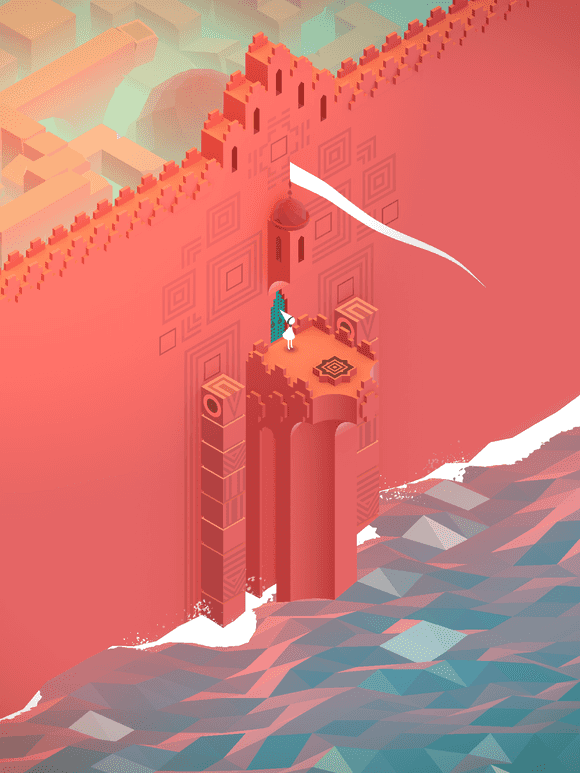
Ten puzzles. Ten gorgeous, mind-bending, paradoxical puzzles. This is a video game you will complete. In fact, Monument Valley may the first video game many will complete. This is by design.

“With so many games, people never see the end, because there’s so many hours of gameplay, we wanted to make a game where you see the whole thing.” - Dan Gray, Monument Valley Executive Producer in an interview with Polygon

As a child, completing a game was a triumph. This was not due to lack time, rather heightened difficulty. Personally, my choice in games was largely based on franchise rather than quality. In turn, this provided me with a library of poorly designed “classics” such as Sonic The Hedgehog and Battletoads. Hours were spent replaying games from Stage 1-1 on to the point where I was forced to power down the console. Check points were few and far between. Save files were non-existent. When asking a video game funding parent if their child had completed any, you’d be hard pressed to receive a positive answer.

I wouldn’t be surprised if this notion has persuaded many audiences away from video games entirely. If they cannot be finished, what is the point?

Now in my late-20s, working 10-12 hours per day, fitting in crucial exercise for a metabolism that seems all but lost, weekends spent running errands that have stacked up, and nurturing a relationship with my soon-to-be wife, I find very little free time to invest in my love for gaming. The minute-to-minute time I do find is spent reading pieces on Polygon or IGN, sharing these with the greater social media landscape. Echoed in Ben Kuchera’s post ”Parenthood makes gaming better by making time your most precious resource,” the value of time skyrockets as we age. The pastimes of yesteryear begin to seem wasteful, yet we strive to retain a connection to our childhood identity. After all, it is the foundation of our dreams. It is who we are and where we are headed.

Since playing Final Fantasy X (recently remastered for PS3 and PSVita) in high school, I have searched for games with rich story. Until the rise of indies, these only seemed attainable through 15-40 hour bouts of character and world building, effectively turning a game into an interactive novel. Fitting one of these epics into my day-to-day has become a near impossible feat.

This is where Monument Valley succeeds. Piling mass amounts of beautiful art and ambitious puzzle design into a bite sized experience is the video game equivalent of a decadent cake. Too much is overbearing. Not enough is unsatisfying. There is a balance.

Monument Valley immediately finds it’s footing through a rich color palette, a soothing soundtrack, and delicate animation. The player understands this world and its inhabitants. The story is used as a mysterious additive that comes secondary to exploring the gorgeous worlds built on paradoxical M. C. Esher design.

Puzzle solving through the discovery of paradox makes the player feel empowered and unstoppable. The experience of breaking illogical boundaries through new perspectives gives players the opportunity to live out their fantasies; it offers a sensation of seeing The Matrix or experiencing the paradox of Inception first-hand.

As the game progresses, the solutions to impossible geometry become more and more difficult to discover. It was not uncommon for me to consciously forget my knowledge of the real world and instead fall back on memories of mazes and Puzzlemania books of my youth. As the difficulty builds, the frustration of adulthood becomes more apparent. Our desire to know how things work is challenged to near breaking point. Even those with a basic understanding of code, animation, and design will scratch their heads and ask of the developers, “how did they do that?” Somehow, the player is able to move the on-screen character through paths that did not previously exist until viewing the vertical world from a different angle. Genius.

It seems the urgency for time has permeated the minds of the developers at ustwo. Monument Valley’s 2-3 hour play-through is the perfect amount of that decadent cake. The experience of Monument Valley is sure to please both the hardcore gamer and casual audiences alike. In fact, it is the perfect example of the importance of short and sweet, possibly introducing these polarizing audiences to a new approach in game design as seen in JourneyThe Room, or EDGE. And like that decadent cake, Monument Valley’s length, design, and puzzles are mesmerizing enough to feel satisfied yet haunting enough to warrant constant craving. If DLC is abound, sign me up.

Monument Valley is available exclusively on iOS (iTunes)


Originally published on TheStarrList.com

Save developers and you will save your soul

  • 130 layoffs, Nintendo (Eurogamer, 6/6/14)
  • 37 layoffs, Harmonix (Polygon, 5/29/14)
  • 20% of staff across development and marketing, Trendy Entertainment (GamesIndustry International, 5/21/14)
  • 16 layoffs, Rare (IGN, 5/19/14)
  • [undisclosed] layoffs, PopCap (Polygon, 3/13/14)
  • 700 layoffs, Disney Interactive (Joystiq, 3/6/14)
  • 27 layoffs, Eidos (Joystiq, 3/4/14)
  • [undisclosed] layoffs, Sony Santa Monica (Joystiq, 2/27/14)
  • 70 layoffs, Irrational Games (Joystiq, 2/18/14)
  • 12 layoffs, Eutechnyx (Joystiq, 2/18/14)
  • [undisclosed] layoffs, Ghost Games (Joystiq, 2/1/14)
  • [undisclosed] layoffs, EA Salt Lake (Joystiq, 1/30/14)
  • 3423+ industry layoffs from 1/7/13 - 10/29/13 (GameJobWatch.com)

In a discussion on IGN’s Game Scoop!, Daemon Hatfield, Greg Miller, Justin Davis, and Brian Altano discussed the Sony Santa Monica layoffs and the ongoing (and seemingly permanent) “ramp up / layoff” structure of AAA studios. During this discussion, the panel made comments around the need for the video game industry to unionize and operate in similar fashion to the film industry:

Daemon Hatfield: “I wonder if the video game industry should be more like the movie industry. You have a crew that works on a movie and when the movie is done, they go on to their next project. They are not full-time employees.”

Greg Miller: “Do you think as far as unionizing?”

DH, Justin Davis, and Brian Altano confirm and agree.

DH: “You have a director that runs a movie, he brings on his crew, they make the game…”

JD: “You assemble a “dream team” for each project. A director has certain DPs and other key positions [and] likes to collaborate with the same people over and over. Presumably all of those people that are one step down also have people they like and they bring their whole crew with them. You get the one guy and then you get his crew.”

GM: “I guess that kind of already happens right?”

BA: “Sort of.”

JD: “It happens a little bit but the issue is that it disrupts people’s insurance and things like that. If there was a union, the equivalent of a SAG card or something, you could just move from project to project. In my opinion (and I haven’t done a tremendous amount of reach on this), but on the surface it seems like something that would be healthy for this business.”

While, many devs may benefit from negotiated salaries, working conditions, hours, and insurance coverage, further research into unions does not seem to offer a terrible amount of protection from layoffs. Nor does it appear that the film industry works this way.

According to Lawyers.com, how a union benefits an employee during a layoff is largely dependent on a collective bargaining agreement (CBA). In short, layoffs of union employees are usually handled on a measure of seniority. The source also goes on to mention the benefits of The Worker Adjustment & Retraining Notification Act (WARN):

Generally, WARN requires employers with 100 or more workers to give you 60 days’ advance notice of some closings and “mass layoffs.” A closing can mean the shut-down of a plant or facility. “Mass layoff” has very specific meanings, but basically it means that a substantial number of workers are being laid off for more than six months. -Lawyers.com

Systems such as WARN would appear to be very valuable for developers in the wake of the seemingly immediate purge of Irrational and Sony Santa Monica employees.

There is a looming fear that if the industry continues at this pace, great artists, programmers, engineers, writers, and the like will be swayed away from from the games industry, potentially diminishing the quality of games released. There is no doubt in my mind that the allure of working on a video game will continue to attract skilled creatives; however, lengthy tenure is sure to wane.

Some will argue that AAA isn’t for everyone and indie development is on the rise. While I agree, many of the skills possessed by indie devs were likely gained from experience at larger studios.

I have never been a developer, part of union, or involved in the film industry. I would appreciate any and all correction of the above information from those with experience.

Should video game developers unionize? Does the film industry actually work in this manner? Does a union offer more protection from layoffs than mentioned above? What is your solution to the state of video game development? Are things fine the way they are?

On Reading

Text has always challenged me. Regardless of copyright date, I look at books as insurmountable volumes rooted in earth’s history, just as permanent and timeless as a mountain or sea. Even the simplest publications feel as if they have always existed, their authors fables to the present day.

And yet, I had always felt a strange desire to write my own novel; to join the ranks of the immortal mystics, scholars and dreamers before me; to create art in a timeless medium.

I grew up in a world that had just given birth to the video game; whose culture was firmly rooted in television soaps, sitcoms and late night specials; on the cusp of harnessnessing the Internet. It was easy to skirt around the written word with spoon-fed visuals and peer-less interactivity. The attention and focus required to unfold a 40-hour story could be easily condensed into a relatively similiar experience of a 2-hour film so why waste my time. With quick summaries from literary classmates and short prayers that a pop quiz wasn’t in my near future, evading grade-school required reading was easy enough.

And then I discovered music. I joined a high-school punk band, and discovered vast amounts of angst fueled lyrics that I quickly paralleled to poetry. I found a connection to the sharp medium with content that could be as dense as a novel yet consumed quicker than a 30-minute televised drama. I toiled over the deeper meanings found in liner-notes and poems. I fell in love with the tiny format, incorporating it into my own lyrics.

This discovery sent me on a journey through college, attempting to challenge even the most admired poetry with lyrics from underground bands. Using this as fuel, I entered college English 101 with the assignment to write a short 5-10 page fiction. I had never attempted this sort of challenge before. I had never even focused the slightest bit of attention on the short-story format. After presenting my completed work (a piece judging myself through the eyes of a close friend), my professor planted the idea that I should pursue creative writing. I took the notion with a grain of salt and continued to focus on music, film and political science.

During the remainder of my college tenure, I realized that I would get lost in writing long-winded reports about Cuba’s standing with the US, the impact of international gangs or research on comparative politics but hated reading the material. While I couldn’t help but feel I was beginning to miss details by solely relying on lectures, cliff-notes and chapter summaries, I still could not bring myself to focus on the dense works in textbooks or even highly praised fiction.

Was it A.D.H.D.? Had the age of electronic media ruined my ability to focus? Little thoughts like these would trickle into my consciousness. While, others found solace in the great works of Tolkien and Vonnegut, I couldn’t focus on Harry Potter.

Then I found The Egg; a short story so profound I trembled to my core. Immediately after the read, the harsh reality of how much I had missed by avoiding the written word came like a rushing tidal wave. Though reluctant, I decided to set off on a journey for beauty in a world built with text.

Like many, I had fallen in love with the Peter Jackson’s adaptation of The Lord of the Rings trilogy. With such respect for the films, I felt a duty to read the source material. After completing The Fellowship of the Ring, I noticed a change in my own vocabulary. Somehow, Tolkien’s words had soaked into my unconscious and allowed me to produce sentences and convincing arguments with gravitas and ease. The impact of reading had become prevalent in my own nature.

I continued hesitating to dive into novels the same way I would dive into a video games of the same length; a realization that left me unable to argue that pouring 20+ hours into any given story was a waste. On top of this, there was a notion that writing was a primitive method of storytelling made better by music, film and video games. Yet, a splinter in my mind told me that there was a single thread that ran though all of these mediums; something that enabled the existence of sheet music, screenplays and punched tape.

The answser was paper. Paper has been a generational through-line for the invention of nearly all forms of art. This was the notion that would propel me to commit to the written word.

Thus, my exploration began. I needed to know how a novelist could invest weeks, months or years into a single piece of work. Just as my technical support training had taught me the inter-workings of computers, I needed to understand the inter-workings of story structure, character development and prose.

I decided enough was enough. If I wanted to understand this medium and conquer my Everest, I needed to write a novel. November 2013 was growing close. I decided to take on the NaNoWriMo challenge.

Since completing the challenge, I have had a much larger appreciation for the written word. That is to say I am beginning to understand the written word at both mechanical and artistic levels. I clamor at the chance to start a new book often times before I finish the last.

Yet, like the scar left on Frodo from the Morgul-blade, there is still a lingering pain in reading. I have not completely tackled the fear that there is simply not enough time to read; that too many profound novels will be left void of my awareness or time before my death that there is simply no point to start reading the wrong ones now.

I love to write. Often times, I dream about the idea of writing for a living. I used to be deterred by the notion that because I was never a reader, I will never be a writer. I now challenge this notion. I offer that it was not until I decided to write that I learned to read. Now that I have learned to read, I hope to learn to write.

Next up: On Writing by Stephen King.


Originally posted on Medium.com