Firewatch: A Review

Firewatch

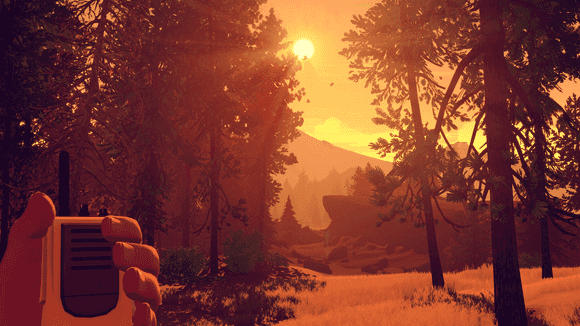
It goes without saying Firewatch is an aesthetic marvel. Just look look at the gameplay screenshot above. Better yet, head to firewatchgame.com and get your fill. But it’s what lies within the exterior beauty that Firewatch shines.

Without taking the Up-like blow out of the first act, the game finds protagonist Henry having taken a job as a fire lookout in Shoshone National Forest, Wyoming. Henry communicates with Delilah, a veteran lookout in another watchtower, via radio through choice-driven narrative queues (à la The Walking Dead, Choose Your Own Adventure). Shortly after the opening, the two find themselves tangled up in a self-provoked mystery.

Throughout my play-through, I became so concerned for Henry’s safety that my own certainty about the wilderness and its role as a haven for the unknown and unexplainable began to fulfill itself. However, it’s at the mercy of a few cheap tricks that this unsettlement is allowed to creep in. One early trick creates the suspicion that something bigger is going on and you’re the only one not in on the secret. Another instills the fear of looking down or turning a corner; two actions that become impossible to avoid and occur at breakneck frequency throughout the entirety of the game. Campo Santo makes it impossible not to feel anxious.

The answer to the game’s mystery will be unsatisfying, but only because this is the wrong puzzle. I’d argue the real answer is to why the game’s mystery is unsatisfying. Therein lies the revelation. Ultimately,_ Firewatch_ shows that one’s own ego and neurosis can overshadow important details; that our narcissism and persistence to seek the puppet-masters blur what is right in front of us. Without doubt, an interesting mystery unfolds for Henry and Delilah; but it’s an exposé in egoism that lies at the heart of Firewatch.

Disneyvania

The release and my playthrough of The Witness happened to coincide with a ramp-up in my video game podcast consumption. (Maybe not so much a coincidence than a subconscious attempt to glean a hints from podcasters.) Through this, I came across a couple of keen observations of the game’s design that I had not considered:

Idle Thumbs, ep 248, 14:55:

Jake Rodkin: It uses so many rules of Disneyland-esque design and video game level design to make it easy to navigate, but it’s not built assuming there’s that huge framework of video game messaging beneath it.

Chris Remo: That Disneyland thing is a good comparison. Video game designers have often—for good reason—and accurately pointed to Disneyland as a really useful design touchstone. Not for the experience of the rides themselves, but for the design of the actual park.

JR: Disneyland is the closest we have in real life to a constructed open-world level.

CR: Areas are connected where there’s an intuitive sense of structure, but when you’re in any given place, it feels like it’s entirely enveloping you.

JR: Until you come around a corner and then the foliage and architecture perfectly frames on a sightline – spire that is in a waypoint to a different land of the park.

CR: And The Witness is totally like that.

I completely agree. The Idle Thumbs crew may also have unraveled a core reason why I loved Myst so much. And quite possibly why I love Disneyland so much.

Jared Petty on IGN’s Game Scoop!, ep 376, 3:27:

This is a secret Metroidvania game. In a Metroid game, you get to an area. You can’t get far. You go off to a different area. You find a power-up. (In this case, the power-ups are not items you find in the game. It’s the knowledge that you gain through working out a different set of puzzles.) You get frustrated. You go off to a different area. You learn something. You come back. Boom! You get through.

Sometimes you can “bomb-jump” your way around it by figuring out something by being clever that you got a little ahead of. Or a little more doggedness or experimentation. It’s a neat game.

A very neat game.

Gaming likely to be big part of Obama's $4B computer science initiative

Polygon:

Game designers know how to create engaging, fun and compelling experiences, he said. They also know how to design an experience that strikes the balance between being hard enough to push a person to learn, but not so hard that it discourages them. Finally, he said, games are great at stealth assessment.

“When you hit level 60 in World of Warcraft, you don’t then take a paper and pencil test; getting to that point is an indication that you’re good at the game,” Kalil said.

Applied to education, those design tenets can be used to create adaptive learning customized to the needs of individual students.

“You’re always going to need great teachers, but I think there are a number of ways video games can contribute,” he said. “Not only will they help with getting more students involved, it will ensure strong interest.”

Lightning and Louis Vuitton

Final Fantasy XIII Lightning, Louis Vuitton

Teddy Dief, developer of Hyper Light Drifter and Kyoto Wild, writing for Polygon:

Square Enix — a major international video game company — thinks that the Louis Vuitton-wearing chic folk of the world might sometimes come home from their fancy parties and boot up their PlayStation 4 or Xbox One. Or you know what? Their Wii U. The fashion in Splatoon is so fresh that it’s inspiring a massive fan zine.

I mean, I’m excited because this is further evidence that the world outside video game enthusiast culture is acknowledging that:

  • Games are for adults too!
  • Game players have fashion sense!
  • There are a lot of women playing games!
  • Fashionistas might be super into turn-based combat!

The stereotypes of old are toppling left and right! It’s a delicious massacre.

[…]

Imagine what could happen!

  • “Diesel to release a line of Bayonetta-inspired pants”
  • “Nintendo reveals Ralph Lauren outfit DLC for Super Smash Bros.
  • “Lululemon teams up with Hyper Light Drifter for a new line of athletic wear”

The three Final Fantasy games centered around Lightning each take an average of 37.5 hours to beat. If these Louis Vuitton designs were to become available in-game, that’s an unprecedented amout of product placement screen time.

Demo Mode: Rise of the Tomb Raider

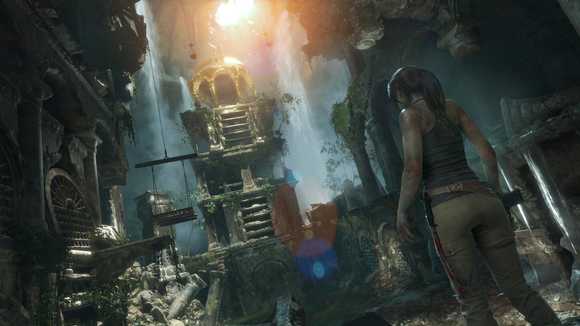
Rise of the Tomb Raider

In the shadow of Naughty Dog’s Uncharted series, I’m not entirely sure it’s fair to say Square Enix’s 2013 Tomb Raider reboot set a bar, but it certainly showed that Square Enix has the chops to add a fair contender to the photorealistic action-adventure genre. To say it another way, if it weren’t for the lack of wit, I wouldn’t have been surprised if Nathan Drake made a cameo. That is a compliment.

Uncharted similarities aside, I imagine Tomb Raider was a welcome reboot of the franchise. Missing a chance with the original Tomb Raider series, 2013’s Tomb Raider was my first-ever jaunt with Lara Croft, and it certainly had me yearning for adventures with her. The mechanics felt nice. There were enough collectibles to make its linear nature feel a bit more open. And it was certainly gorgeous.

However, having never played the original Tomb Raider series from the late-90s, I was unfamiliar with the concept of raiding tombs. Thinking back on my play-through, the reboot had very little to do with it’s namesake. Many Tomb Raider reviews called out the lack of the core aspect of the franchise. In any case, my enjoyment with the reboot left me unquestioning of the game’s title.

Square Enix’s sequel/prequel (the trial doesn’t paint a fair picture of the timeline) Rise of the Tomb Raider appears to have a greater focus on tomb raiding. Various reviews have highlighted that this new focus paired with an open-world nature make for a compelling follow-up and something that is varied enough from the first.

During the Rise of the Tomb Raider trial, I did not have an opportunity to experience either of these aspects. It opens with the player scaling an icy and crumbing mountainside — an Uncharted 2 opening train-scene equivalent — to a lost city and a tomb within. The visuals are stunning and, like the first, the mechanics feel polished. (This coming off of Assassin’s Creed: Syndicate which feel clunky to a franchise novice. A story for another post.) After entering the ruins of the lost city, the player is treated with a fairly simple puzzle of rising water and platforming. Unchallenging, but it gives the impression that this type of puzzling will be core to the remainder of the game.

The hour-long trial is ripe with cinematics: the opening, a few during the mountain climb, a flashback highlighting Lara’s father, and the ending. I’d hope that the remainder of the game strays away from the heavy-handed cinematics and quicktime events, opting to focus more on puzzling within tombs. The trial ends in a rushed cinematic with an unnamed baddie, a “shootout” with two henchmen, and a race out of the tomb before it comes crashing down.

Without relying too heavily on reviews elsewhere, the trial of Rise of the Tomb Raider feels like more of the same, albeit a bit prettier than the first title in the franchise.